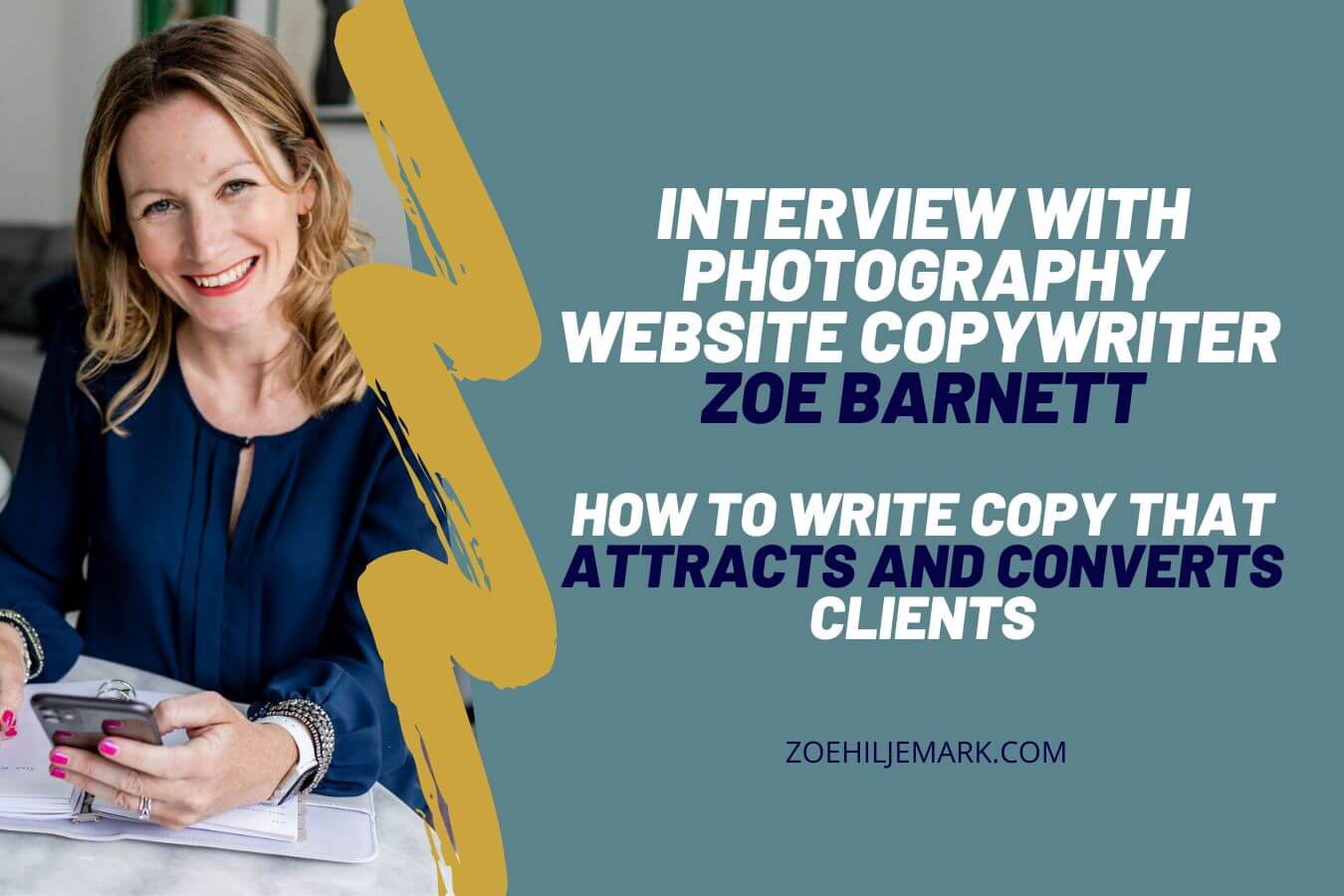
How To Write High-Converting Website Copy for Photographers: Interview with Zoe Barnett
In this exclusive interview, I’m joined by website copywriter and SEO strategist Zoe Barnett of Zo Connected, who specialises in working with creatives, photographers and service-based businesses.
Zoe comes from a corporate marketing background but realised over time that it was the words she loved most. That led her to transition into copywriting, and eventually into the specialist niche she’s known for today: strategic, personality-packed website copy that helps creative business owners get found and booked.
Photography website copy that sounds authentic and attract clients
In our conversation, we dig into why so many photographers feel overwhelmed by the task of writing their website copy and what to do instead.
Zoe talks about:
- How to break the copywriting process down so it feels manageable rather than terrifying
- Why your homepage should be your “North Star” and how it shapes the rest of your site
- What brand voice actually means (without the jargon) and how to find yours
- How to write a non-cringey, genuinely useful About page
- The role of clear, well-placed calls to action in turning visitors into enquiries
- Where AI tools like ChatGPT can help and where human editing is still essential.
If you’ve ever stared at a blinking cursor on a blank Google Doc, wondered what on earth to write about yourself, or felt unsure how to make your photography website copy sound like you while still attracting your ideal clients, this one’s for you.
Read on for the full interview with Zoe, packed with practical, down-to-earth copy tips you can start using on your photography website straight away.
Click this link or on the video preview below to listen to or watch my chat with Zoe about all-things photography website copywriting. Alternatively, scroll down to read the full transcript.
How to approach a photography website copy rewrite
So many photographers know they should improve their website copy, but quickly hit a wall of overwhelm. Zoe explains why that happens and how to get unstuck.
She advises that instead of trying to “write the whole website” in one sitting, try breaking the task into phases and starting with your homepage. Once you’re clear on the message, structure and flow of that one page, the rest of your site (About, Services, Contact, blog, etc.) becomes far easier to write.
Brand Voice – What is it and why is it important?
In this interview, Zoe and I also talk a lot about brand voice – i.e. “how you sound when you’re talking to your ideal client on a really good day”.
Zoe shares practical ways to pin that down, from listening back to client calls and pulling phrases from testimonials, to noticing the words and expressions you naturally use. She also explains how your brand voice ties everything together when you shoot in more than one genre (for example, weddings and families, or headshots and pets), so your site still feels cohesive rather than disjointed.

Copywriting key pages of your photography website
From there, we dive into specific pages that photographers often struggle with. Zoe Barnett breaks down how to approach your About page so it feels like a genuine conversation rather than a cringey CV, and how to weave in personal details that actually serve the client.
We chat about structuring Services pages for different niches, and why sprinkling testimonials, links and calls-to-action throughout your pages (rather than dumping everything at the bottom) creates a smoother journey that’s more likely to lead to an enquiry.
The important role of compelling Call-to-Action website copy for photographers
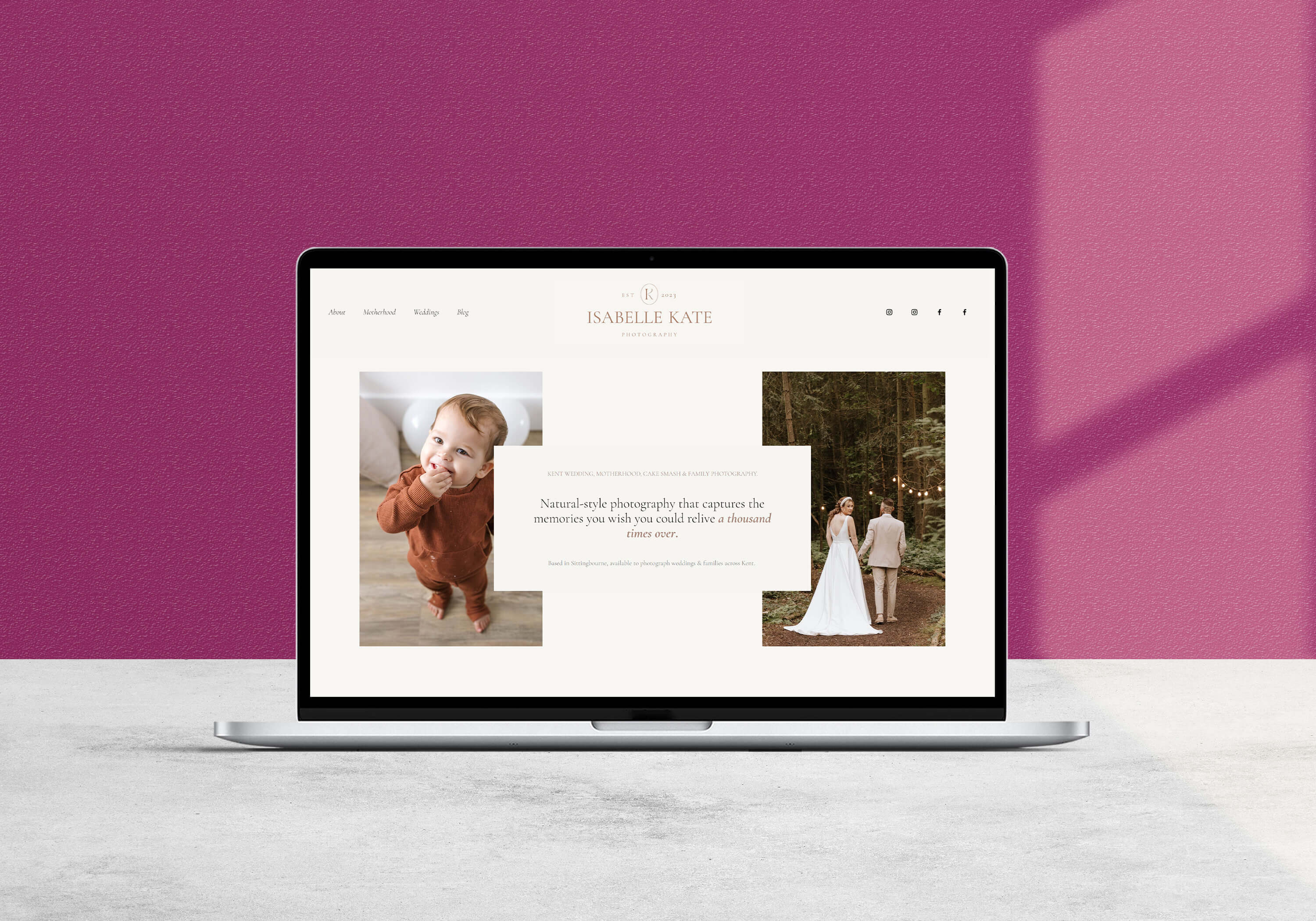
We also touch on the role of calls-to-action and “microcopy” – those small but mighty button labels and prompts that quietly guide people around your site. Zoe shares simple ways to make them clearer and more compelling, without going so quirky that visitors don’t know what they’re clicking on.
And yes, we tackle the big topic of AI tools like ChatGPT: when they can be genuinely helpful, when they fall short, and why human editing is still non-negotiable if you want copy that sounds like you and converts the right clients.
If you’ve been putting off updating your website because the words feel too hard, this conversation will give you both reassurance and a roadmap.
Watch the interview and subscribe for more
Catch the interview with Zoe Barnett here on my YouTube channel or click on the video below to learn how to attract, engage and convert more of your ideal clients with thoughtful, strategic copy – without having to become “a writer” first.
If you enjoy it, please like, comment and subscribe while you’re there. Alternatively, you can read the transcript below if you’d prefer.
Zoe
P.S. As we mention in the interview, Zoe and I have co-created a copywriting and PR template, which is available to purchase here on my website. It’s a tool you can use to strategically build out your website copy and make your site irresistible to both dream clients and the media. Get your copy for just £55.
LINKS & FURTHER INFORMATION
Discover Zoe + Zoe’s website and PR templates
Other Interviews in this series
Copyright & Reproduction Notice: This interview may not be reproduced, republished, or distributed in whole or in part without prior written consent from Zoe Hiljemark. Proper attribution is required for any authorised use or excerpting.
Video Transcript
Zoe Hiljemark: I’m with Zoe Barnett today. She is an SEO strategist and professional copywriter who works with creatives, photographers, and service-based businesses. Welcome Zoe. I’m so delighted to have you here, and I can’t wait to talk about copywriting.
Zoe Barnett: Hi Zoe. Thank you so much for having me.
Zoe Hiljemark: Do you wanna tell us a little bit about you and how you got into copywriting?
Zoe Barnett: Yeah, absolutely. I am a website copywriter and SEO strategist. I come from a corporate marketing background. A few years ago I decided, hang on a sec, and I think I can go and do this myself started off in a very general marketing background, but realized I’ve always loved words. So transitioned more into copywriting and obviously a big part of website copywriting is the SEO side. So that is where I am today.
Zoe Hiljemark: Brilliant. Well, we’re gonna dig into that because I know that photographers in my community and, and overall in the genre really can struggle with copywriting because they’re fantastic at obviously the visual side of it creating beautiful images.
But sometimes, you know, you need more help with marketing those beautiful images. So of course, for the benefit of those photographers who might be thinking, yes, I need to get some copywriting tips, how can I actually convey the value and the passion I have behind my work? How would you advise a photographer who’s struggling with writing copy that’s really gonna speak to their ideal client?
What would be like a quick tip or tips that you might be able to share? And I’m presuming we wanna get across our personalities and obviously our unique take on the world and our approach to photography. But can you tell us a bit more about how you might tune into a photographer’s voice and recommend that they tap into that in their copy?
Zoe Barnett: Yeah. And of course there’s, there’s a lot to unpack there. And website copy is I think the biggest thing, even me just listening to you. Then I think the task of writing copy, feels so overwhelming because what usually happens is a photographer comes along and photographers are naturally creative visual people, and they think, right, I want a really fantastic website.
So it’s usually a couple of avenues. You get a template. There’s lots of great free templates, or you invest in a template or maybe you work with a website designer, you hire someone to do your website, and then all of a sudden you think you are in this process of, of building your website or maybe rebuilding your website and you think, right, I’ve gotta now fill this with words.
So either your website designer says. Where’s your copy? I need your copy. Or you are doing it yourself. You are, you know, filling it within a template. And the biggest challenge is it tends to be overwhelm. And you think, right, I’ve gotta think about brand voice. I’ve gotta think about headlines. I’ve got to think about SEO and there’s so much to think about.
So in terms of like one tip. To banish that overwhelm, though there’s not, there’s not a magic cure. But the thing I would say is break the task down. When you underestimate what’s involved with writing website copy, if you think it’s something that you can just chuck together in a day or, you know, spend a few evenings doing.
I’d love to say it was that easy, but you’re actually making it more difficult for yourself. But if you can break the task down, you know, give yourself a month to work on it and break it down into the phases that’s needed, that is when it becomes less overwhelming and actually manageable to create the copy that you need to strategically attract those ideal clients that you want to work with.
Zoe Hiljemark: That’s great advice. And actually that’s true for everything, isn’t it? If we get overwhelmed, to think about it in a more granular fashion, that’s a great tip. And I can totally see that, having written my own website in the past and rewritten it. Yeah. Yeah. It’s a huge task, isn’t it? So you would, I guess, then be suggesting that you’ve approach one page at a time.
So are you thinking homepage first about Page Next Services page? How, how would you kind of approach it?
Zoe Barnett: Yeah, so that’s the traditional way to approach website copy. What I do as a professional copywriter, and I actually do this when I work one-on-one with clients, is we use the homepage as like the north star, your guiding star.
So if you can nail the homepage, if you can get that right, then that is gonna help you write all your interior pages so you know your about page, your services page, contact page. This is where you really wanna spend your energy, and this is where you want to be really clear on your messaging and your brand voice and the strategy of your website, and by the strategy of your website.
I mean, how is it actually gonna work? How is it gonna flow? How are you gonna direct people to one key sales page? Are you gonna have a main service? Are you gonna have secondary services? If you can map that out so you can write your homepage and, and map out all these things, what’s my message? What’s my brand voice?
What’s my website strategy? Then everything else is gonna flow on from that. So yes, definitely start with the homepage.
Zoe Hiljemark: Okay. I know what you mean by brand voice, but let’s break that down for people. So brand voice, what is that? A lot of photographers are obviously independent; they’re working on their own. So arguably, their brand voice, you could say is their natural voice as they speak because they are the business owner in the face of the business. But could you just sort of elaborate on that term and explain what you mean a bit more, just in case people aren’t clear on that. And also how you would define it if you are unclear.
Zoe Barnett: Yeah, and I think you know how you’ve described it there, Zoe is. Perfect, because it shouldn’t be something that’s over complicated. And I think when it is over complicated, that’s when it becomes a bit wishy-washy. So I’ll explain.
A brand voice is essentially the words that you use, how you talk. How you come across to your ideal client. And the easiest way to do that is to be authentic. So what I mean being authentic is lean into a version of you that you know is your best self when you are with. A client who is your ideal client. And the reason I say it in that way is take the pressure off a little bit.
So, you know, I’m as a copywriter and I’m a business owner, I’m a creative business owner, and I know when I’m speaking to an ideal client, because I know that I speak their language. That we click, and we’ve all been in those scenarios where you just click with someone and you know that it’s gonna be a really good working relationship.
And whether you are a wedding photographer, a nature photographer, a brand photographer, you’ll have felt, or you, you would’ve at least had, even if it’s not converted into a sale, you may have had situations in networking where you’re speaking to someone thinking, gosh, I could really help this person. I could really help this business.
Leaning into that version of your voice is the easiest way to do it. Practically. How to do that is setting some time aside to think about the kind of phraseology and words that you use. And again, don’t overthink it. Just think naturally. What would you say to that ideal client? And those words will come to the surface.
You know, you think about certain words that resonate. You can do things like look through if, if you have testimonials, if you have reviews, look at the language , how they’ve described you, words that they use. I’ve actually had clients do this where they record conversations back with their clients, their existing clients, and they listen to how they speak.
And you can use that to guide yourself. So to tighten up what is already in you, okay? But the biggest thing is to not overthink it and just be yourself. Talk, you know, like yourself.
Zoe Hiljemark: Yeah. I think that there was a time when everybody spoke more formally on their websites, and I think that very much is becoming not as popular and people are being, like you say, their authentic selves on their website because we understand now that actually we don’t need to write formally like we did at school, how we were taught. You know, you can start a sentence with the word ‘and’ or ‘because’, for example and all of those rules that the school system taught us are actually no longer relevant because people want that authentic interaction with certainly an individual that they’re about to hire or considering hiring in this case as a photographer.
So yeah, I think that’s good for those people who perhaps maybe didn’t get on at school, a lot photographers can really struggle with words. And actually that must be quite a nice thought that, you know, actually the rule book doesn’t even exist anymore.
Zoe Barnett: Oh, absolutely.Yeah. I mean, I read something a while back, this, and it really stuck with me. It said conversational doesn’t mean casual. Just because you’re conversational doesn’t take away from your professionalism, you know, it doesn’t mean that you’re casual about your business.
That is something that I’ve said to clients loads who, you know, maybe do feel more comfortable being in the more formal sphere because maybe that’s what they’ve learned and that’s what they’ve been taught. But actually, you know, what really resonates is when we just speak to people like a real human being. The person that you are.
Zoe Hiljemark: Yeah. I love that idea because that is so impactful. And we do need to be professional. Of course, we do. We need to present our services, our products, in the best possible light. We need to highlight the benefits and the positives and all the good things that can come from hiring us. But I think, yeah, like you say, it doesn’t need to be formal. It can be done really well if it’s conversational, so I love that advice about being conversational, being yourself. And there’s some really good tips that you’ve shared there about recording yourself or listening back to conversations.
How do you work with a client firstly, to get to know someone’s brand voice because you are writing on their behalf, of course. So how might you do it? Same thing, just conversations, taking notes, listening back or…?
Zoe Barnett: Yeah. So it, it really starts with you know, if someone’s working with me one-on-one is the first thing that we do is a workshop. And that’s how we start the whole copywriting process. And that workshop is recorded. So I listen back to that. So that’s very much like phase one of me understanding what the voice is. There’s also, obviously the market research, what are the competitors out there saying?
What are their clients wanting them to say? Again, looking at the testimonials and it’s very much like a meet in the middle, you know, when we’re looking at it from a very strategic point of view.
Obviously if you are gonna DIY, your copy, if you’re gonna write your own copy, I would say, go out there, get inspiration, look at what others are doing, but lean more heavily into what feels right for you, because that’s how you are gonna create something that’s more authentic and real and actually genuinely you, rather than copying a competitor.
When I’m working with clients, they tend to be more at the stage of their business where they’re starting to invest in their business. Maybe their business is hitting, I usually call it like a tipping point. Like where, you know, a photographer knows that they need to invest in their website in order to kind of get to that next level. So the process does look different than, you know, the DIY approach. And then we come at it from the market research. So what are people doing in the market? What do people want to hear at the moment?
So yeah, that’s competitor listening. Looking at their websites, competitors’ websites, and understanding the terminologies, the words that they’re using. Trends. Sometimes we don’t wanna just kind of do everything to be on trend, but there might be certain words that are really resonating in the market. And then that’s when I would advise a client, you know, when I am rating the concept for the web copy, they might say, well, I never say that.
And I say, well, I don’t want a hundred percent of your words to feel like that, but maybe injecting a little bit of this and a little bit of that and start saying it would actually make you resonate more with those kind of clients. So it is really looking very granularly at the words that are being used, the phraseology how they use their web copy.
So how it’s broken down, how it works with the design, the overall experience that builds into everything that kind of creates their, their brand voice and their messaging. ’cause that, you know, they, that and the strategy of the website, ’cause they’re all interlink. You can’t really just do one without the other.
Zoe Hiljemark: No, that’s actually a really important point because it’s all very well writing 300, 400, 500 words for your homepage. Coming back to the template and finding, oh, it doesn’t fit the design, that the blocks of space you have available don’t work. So I know you’ve got a clever hack and that is your template in terms of how you might actually.
Be considering the space available as you write. So, can you tell us about that? And obviously we worked together recently. We are recording this in early May 2025, but just back in March we recorded a workshop together, didn’t we, and created a resource. And as part of that, there is a template that Zoe put together, and then there’s some PR templates I put together. The template helps with that problem, doesn’t it?
Zoe Barnett: Yeah, so the template, what is really good for is if you are going out and DIYing your website and obviously DIYing your copy, you know that you can go on chat, GPT, use AI to write your copy.
But what AI fails to give you, whilst you can tell it to give you. You can tell it that you’re writing copy. It fails to visualize how it may map out on the page. So when we work together, what I created was a template, a website copy template that considers kind of the flow of the copy and the way that it can work with visual elements and the strategy, therefore, of the website overall.
And I don’t wanna use buzzwords, but strategy is very much like how it flows from one section to the other. Just think about your ideal client on your website and how they navigate around it. Yeah. So the template is really good for giving you that, that guidance. Sure. Use ai. Use AI to polish your words and give you inspiration, but essentially what the template does is give you a starting point to say, this is how to write websites that work.
And you know, I don’t just say that in any way. This is, you know, someone who’s written for many, many websites and worked with designers. This is the formula that works. Yes, you might need to customize it. Yes, you may need to change things around. But essentially that template is what is a tried and tested strategy for photography websites.
Zoe Hiljemark: It helps people get the key parts in, doesn’t it? And I think, you know, that’s the risk when you’re doing it on your own. You can like say, use Chat GPT to churn out a load of copy, but it needs a lot of refining and like you say, has it actually included all the key elements that you need?
So let’s talk about if a photographer has got two genres, so perhaps they specialize in weddings as well as family portraits or newborns, for example. How might you suggest a photographer tackle that from a copywriting perspective? We’ve said earlier about having the homepage being that main page.
How might you – not so much structure, ’cause I think that’s more about the website. design, and I talked actually with Alex Vita about website design in a previous video – but more from the copywriting perspective…how might you approach it if you are a specialist in two or more genres from a copywriting perspective?
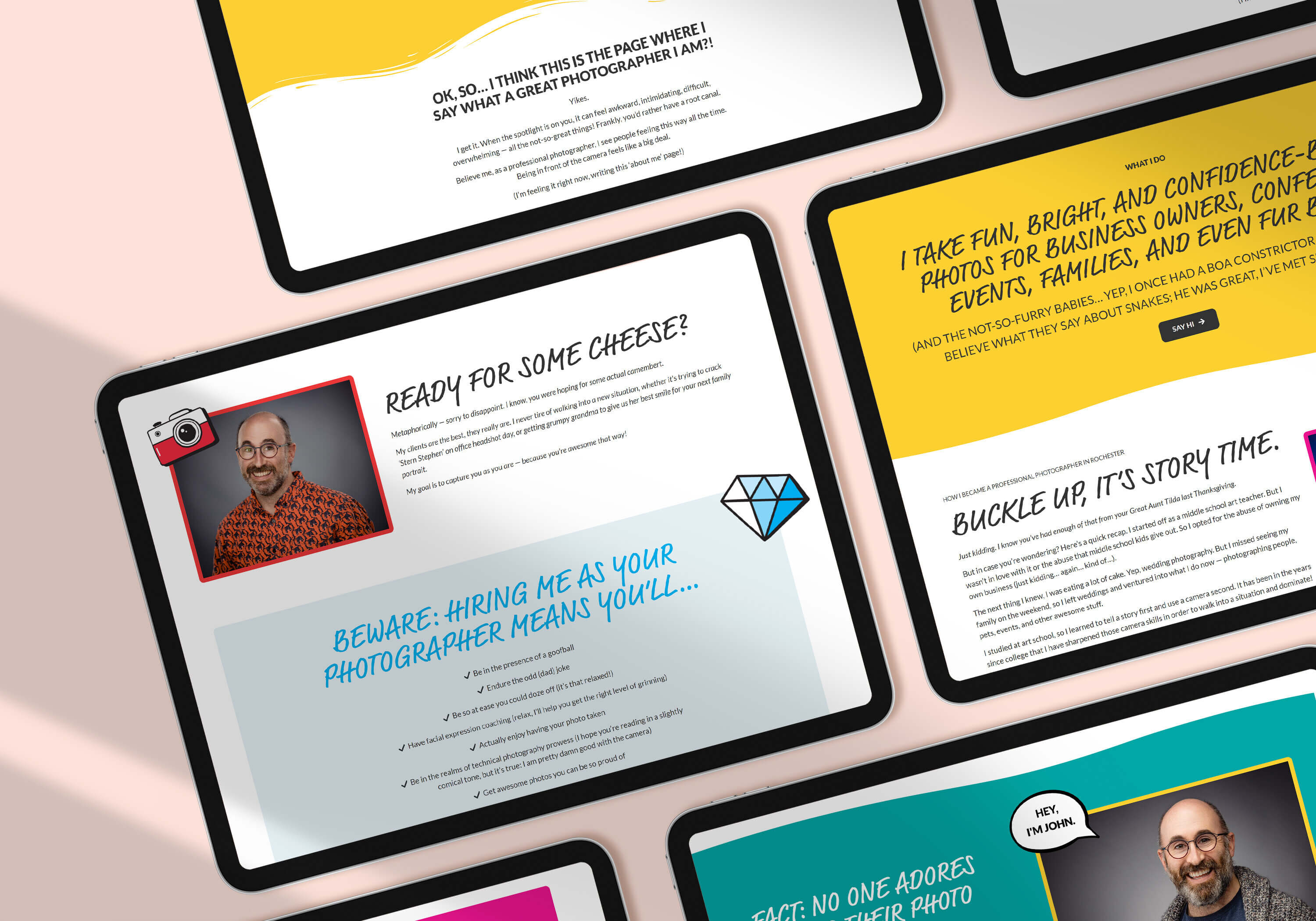
Zoe Barnett: It’s really nice that you mentioned Alex Vita, actually, because I can use an example that him and I collaborated on. So he is website designer, I am website copywriter. It was a custom project. So this client, John, who came to Alex initially, was ready to go all in, get a beautiful new website. He was a headshot photographer, predominantly. That’s what he was known for, but he also did pet photography, family photography, and editorial photography as well. So, there were many different branches and different audiences, ’cause straight away, you know, your pet photography client is gonna be completely different to your headshot client.
And interestingly enough, this is a challenge that’s not just in photography. It’s across a lot of different niches. So it’s something as a copywriter that you have to be well versed at. I actually asked ChatGPT once how to approach this and ChatGPT told me to do separate websites through each niche. In an ideal world, okay, maybe in an ideal world, and if you are a big business, you know you have different brands and different. You know, audiences and you build the brand around the audience.
But we’re talking usually micro, small businesses here. It’s just not you. So the next best thing is to have individual services pages. You know, obviously, for your family photography, for your brand photography. And what you want to do is, again, going back to this homepage, is create messaging that can tie in to all elements. The challenge is then having wishy-washy messaging. Because if you are trying to appeal to your brand photography or headshot photography people and your pet photography people, you know, how can you actually put a message together that is gonna resonate with both?
So my strategy here is usually to ask, Do you have a primary service? If you have a primary service, this is what you kind of wanna focus on in that hero section, that main message. So in John’s case, his messaging was very much about making people feel good. Then if you looked at his homepage, you would then go down it and there would be almost like a jokey bit about making people feel good and making granny feel good in the family photography.
So it’s about having a message that you can dial up and dilute down as well. Okay. So you need to think about a message that you can dial up to your pet photography clients or your brand photography, but it’s got to feel the same. John’s comment at the end of the project was that he was really happy with the cohesive feeling. It felt like him across it all, even though he was talking to different people, even though the messaging did vary depending on the audience, and that is where your brand voice comes in.
So yes, you’ve got different messaging, but as long as your brand voice is cohesive, people are gonna know whether you are talking about you are photographing someone’s dog or whether you’re photographing, you know, colleagues at somebody’s business, then it’s the same person and it’s still that same overall brand vibe.
Zoe Hiljemark: Nice. I like that. And I think, yeah, so dialing into what it is that’s relevant across all genres, I think is what you’re saying, essentially.
Yes. And then get that across in the homepage, but with those additional services pages, which also then allow you to talk more specifically about that niche. Mm-hmm. And of course, from an SEO perspective, both you and I work in SEO and copywriting is, is so important in terms of getting those key phrases in.
Zoe Barnett: Exactly. What you’ve gotta remember is your services pages are your opportunity to really dial it up, and naturally, if somebody has landed your website, whether it’s, you know, if it’s via Google, they might land on that service page anyway because they’re Yes.
Zoe Hiljemark: If it’s well optimized. Yeah, why not?
Zoe Barnett: Exactly. Exactly. If they’re going to your homepage, it may be that, you know, they come via your social media or, you know, maybe they’ve had a referral. And then even then, if they are looking for something very specific, they are gonna navigate to that page, that specific page. So as long as your homepage reassures ’em straight away that they’re in the right place, then they’re gonna quickly navigate to the right place for them.
Zoe Hiljemark: And of course, having a great navigation and the menu being very clear so that you can get to where you wanna go to. And that again, we touched on with the interview with Alex, but that is really important. But like you say, we’re all quite tech savvy these days and can navigate the sites presuming they follow that regular format.
But let’s talk about about pages. ’cause I know that about pages can be the second most visited page because people want to find out about you if they’ve got some interest. Can we talk about the copywriting for about pages? It can be so cringey, can’t it? Writing about yourself.
I know photographers struggle with this. How can photographers build that trust and connection and appeal and desire for hiring them without that cringey overload and real salesy type speak as well? And, what should they include in an about page? Is it actually about them or should it more be about the client and the issues that they solve?
Zoe Barnett: So that is a really common phrase that that gets banded around quite a lot in the marketing world that you’re, your about page isn’t about you, it’s about them.
And fundamentally I agree, but I find that gets people more in a pickle about what to write because then they’re thinking, right, this is my about page, but I’m not allowed to write it about me. It’s gotta be about them. The simplest way to describe what an about page should do is it should be like.
Sitting down with your ideal client and having a really good conversation with them, and again, having that really like you are really engaging to them. They’re engaging to you. Your homepage should be about you, actually should be about you and your business, but it should be the bits that align and resonate with your ideal client.
The stuff that’s gonna make them think, oh, that’s interesting. You know, I want to learn more. Practically how you do that is have a bit of a fun with your about page. I love a fun about page. So if you break it down, the simplest way is beginning, middle, and end.
So at the beginning of your about page, strategically, what you want to be doing here is like engaging the nurturing the ideal client. And the reason I say that is if you look at your homepage, that’s where you attract them. You hook them in you, you say something that makes ’em think, right, okay, I wanna explore more.
When they’re on your about page, this is about them wanting to know more about you and your business. They’re wanting to know more about you, especially as a photographer, because you know it’s very personal, isn’t it? Whoever’s gonna be photographing you or your subjects, you want to feel the right is the right person.
So that hero section at the top, this is where I say use a statement that’s gonna resonate with them straight away. Okay. Then when it goes into what is on your about page, this is where you see people just write massive bios or almost have like the CV approach, which is not the best approach.
I understand why people do it for ease and getting started, but what you wanna do is really think about your story and then how it, it goes into their story. So, for example, if you are a family photographer, it would be a really smart move to pick out bits about your own family life and how that links into you being a family photographer again, resonate with your ideal client.
If you are a brand photographer, you might want to talk a little bit more about your journey and your business. You wanna pick out elements of your own story. And a lovely tip that I like to share is start in the middle. So you don’t need to start right at the beginning of the story, but think about a poignant point in your own story that’s gonna resonate with your ideal client. It could be something that’s that’s personal to you, and then build that out on your about page. You can also include really simple things like testimonials are great on and about page.
I like really fun things like picking out your five favorite things. You know, a snapshot of something personal like your dog, you know, like, John, the client I was talking about before we used a silly picture of his dog. Things like that can, depending on your approach, can be really fun.
And then obviously really clear call to actions. Tell them what to do at the end of the about page. You know, tell ’em where to go next because they’ve read a load about you, they like you, and now they’re gonna continue.
Zoe Hiljemark: I’m glad you’ve touched on call to actions, actually. ’cause that’s a key part of the copywriting piece, isn’t it?
Like ultimately you can write all this amazing copy, but if you’re not driving them to a different page or a contact form that’s a lost opportunity. So let’s talk briefly about call to actions and how photographers can move forward from just saying, click here. I see that a lot. How can we convey our brand voice again in those call to action buttons? And how important is that?
Zoe Barnett: Yeah, I mean, again, there’s, there’s a couple of things to consider. So it can go both ways where people try to be really quirky and really interesting, and then the call to action’s just become a bit too much.
Usually what you wanna be going for is simplicity. So it’s absolutely okay to say like, head this way or whatever sounds natural to your voice. But also, what I would say is be very specific call to actions and make sure it’s clear what the call to action is actually for.
So you could have a call to action that says head here, but then they don’t actually know why they’re heading here. So have you told them in the copy? You know, sometimes it can just be a really little line of copy that says want to get started? And then the button says, apply here so it’s very clear why they’re pressing that button.
If you think about yourself exploring a website we wanna explore it as quickly as possible. So giving people very clear navigation with the call to actions really helps. But yeah, using your brand voice write button copy and, you know, make them fun.
What I would say is that’s a really lovely editing task, so write your copy have fun with it, and then read back your copy and then think about how you can just make your call to actions a little bit more interesting.
You don’t need them at the end all the time. You know, they can be throughout the copy really naturally. And I think that’s, that’s one thing that people forget is, you know, that they tend to have the big call to action at the end, like, do you want to work with me? Click here.
What you can have is have more subtle ones. That’s where your microcopy comes through throughout your, you know, whether it’s your sales page or whether it’s your homepage that allows people, gives the user that power to explore things on their terms.
Zoe Hiljemark: Yeah. I think that you’re so right. When you’ve got a blog and you’ve got other articles that are related to a topic, don’t necessarily dump all the call to action links at the bottom of the article because you can’t assume that people are making it to the end of that article to then discover that you’ve got something else on a similar topic that’s also of interest.
So I always tell clients and help clients with their copy in terms of interspersing them where relevant, and you’ve mentioned testimonials, again, intersperse them into your copy. Don’t just dump them at the bottom or have them on like a testimonials page, but nowhere else on the website, for example.
So trying to make that page experience all of the pages across your website is interesting as possible by breaking it up into sections. Having those call to actions, I think is good practice really.
Zoe Barnett: Yeah, I love the tool, Hotjar. I know there’s, there’s other ones that people can use, but Hotjar is really great and, you know, I ask clients to plug it into their existing website so we can watch how people…
Zoe Hiljemark: Yeah, you can watch people literally using your site, can’t you? And see when they get stuck and where they click and…
Zoe Barnett: Exactly, yeah. ’cause you know, through the copywriting process that should help guide them the design as well. And we say, you know, copying design work hand in hand. So yeah, that’s a really awesome tool , it’s free, you can plug it in and watch what people do. And I actually quite enjoy it.
Zoe Hiljemark: I’m glad you mentioned that. ’cause one of the questions I was gonna ask you was what tools would you recommend, if any, we’ve already touched on AI tools, ChatGPT etc. Do you vouch for those or would you say they’re a great starting point? Or would you say try to avoid them if you can go with your own words as as starting point? How would you approach that and what are the tools that you recommend?
Zoe Barnett: Yeah, as a copywriter, I suppose. It’s a very complex issue. ChatGPT, I will say though, for many people it makes copywriting a lot more accessible and creating copy for their website a lot more accessible. And, you know what, that is only a really good thing. Depending on who you are, and your personality and how you enjoy using technology is really whether you should use it or not.
I think that’s very much like if you are somebody that enjoys sitting down and using actual tools to generate things and you’re more of like a techy kind of person, then you are gonna enjoy prompting. And I think that’s when you need to be able to engineer really good prompts to be able to get ChatGPT to create good copy for you to a certain level.
I think there’s always a level of human refinement. You can never just kind of take Oh, without, without. Yeah. That is my one rule is if you’re gonna use it, just please have an element of human refinement. ChatGPT gets things wrong. AI gets things wrong. The biggest issue I think is it gives you too much, and you can tell it to cut stuff down and I think if you are in tune with AI and you’re using it for other elements of your business, then absolutely.
Like you, you feel comfortable using it, then yes, use it. If you are not, if you’re more of a, not really into it yet or maybe you’re just trying it, then that’s when I would try and I would advise maybe the more traditional approach of having a go, but have a go with a template. So like the template that we created together, I think a template is an absolute great kind of middle ground.
In fact, I’ve actually had clients that have used both. So they’ve used the template and then they’ve used the prompts within the template to help them generate their copy. And then they’ve had the human editing element at the end. Yeah. And then another big tip in terms of like getting started and just getting some words out there is take the writing element out of it and like sketch out your copy, you know, work out what’s gonna go where, what headings are gonna go there.
Start right at the top. Don’t think about every single word having to be right straight away. So if you are somebody that wants to write it yourself and lean into that, that’s where I would start is just simply get a pen and paper and scribble some ideas down. Imagine what heading goes there. What goes in the hero?
What’s your main heading? Have fun with it. Play around with it. Think of it as more of a visual task than a. Having to stare at a blank Google Doc. ’cause there is, even as a copywriter, there is no worse feeling than opening up a blank Google Doc.
Zoe Hiljemark: Yeah. That flashing cursor. It can be very overwhelming.
Zoe Barnett: Definitely.
Zoe Hiljemark: Yeah. Getting something down, I think it goes back to your point you made earlier on in the sense of breaking it down, but page by page arguably. But giving yourself enough time to really think through what each page needs to. To strategically provide the visitor in terms of the information that they’re gonna need to understand.
And I think all of this stems back to understanding your ideal client, who it is that you’re actually trying attract and convert with your copy and your website and thinking about what they might need to know, what. They might not already appreciate or understand about your service what they might misunderstand and all of those things.
So it’s all, all marketing essentially is fundamentally all about your ideal client and understanding them. So yeah, I think certainly in the copy sense, you need to really break that down, don’t you, and understand what they need.
Zoe Barnett: Yeah. And the templates that we did together and the templates that I do generally take you through that. There’s three main stages that I talk about, and it’s attract, engage, convert, if you can get those main three things right on your website. Through your website copy that is strategically the best way to nurture someone through from being, you know, landing on your website to actually sending an inquiry.
And essentially the attract bit is about hooking them in. The engaged bit is like, you know, let’s keep them in a conversation. Let’s make them feel at home. Let’s make them feel happy, excited, you know, that they’re in the right place. And then the convert bit is giving them the right bits of information, the things that they need to know and feel reassured about in order to kind of take that extra step, whether that’s filling out a contact form, sending you an email, making that bit crystal clear.
So that template takes you through that process. And I think that is where, you know, if you are coming at an AI tool, just asking AI to write you copy.
AI will spit out sales copy, but it, unless you really exactly, explicitly tell it, it doesn’t necessarily do that strategy side of things. It doesn’t think through it like that. And also think through it with the design. So I think that’s where you can fall down with ai.
Zoe Hiljemark: Yeah, there’s so much potential with these tools. Like you say, it’s a great leveler. And so it’s very exciting for the photography industry to be able to improve copy that may previously have not been that strong. But obviously yeah, avoid the pitfalls of, not editing it to your brand voice and all the things we’ve talked about…changing it so that it is tailored to you.
And yeah, use it wisely essentially. Yeah, and I think at the time of recording this, AI has been around a while now, so. People aren’t making the mistakes as often. I’m seeing on social media, kind of far less cringey, clearly written with AI-type copy that I saw, you know, sometime back – it was just so obvious! So I think we’re, everyone’s learning, aren’t they, to use these tools and get the better outputs from them.
And ultimately I think you would argue that, strong copy will help with that conversion of your ideal clients and lead to more inquiries and sales. So this stuff is really important to nail.
All these tips you’ve been sharing have been super useful, hopefully for those listening and watching, so thank you ever so much Zoe for your guidance here. It’s been really fun to chat. And of course, we’ve collaborated before. We are talking about collaborating again in the future, so people interested in all things PR, SEO, copywriting, the kind of topics that Zoe and I both specialise in…watch this space ’cause more will be coming soon.
Thanks ever so much, Zoe for your time today. It’s been brilliant chatting with you.
Zoe Barnett: Thank you Zoe.